
 Horace
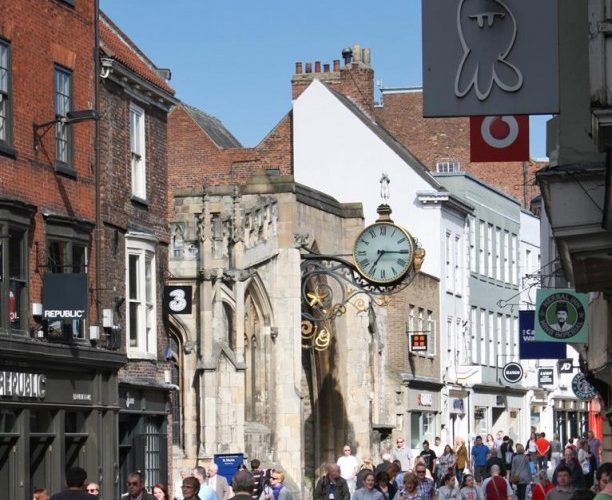
 Coney Street, is recognised by its large landmark clock that protrudes above the shoppers below. One of York’s main shopping thoroughfares it is as popular today as it ever was.
It is first found on records as early as 1213 when it then went by the name of Cuningstreta, from the Viking words Konungra – king, and straet – street, Kings Street. No doubt local traders and merchants would have sold their wares on the street even then. Coney Street follows the path of a section of one of the Roman roads that were situated to the outside of York’s Roman fortress and which lay practically parallel to the River Ouse’s eastern bank.
Coney Street was at one time defined as three separate stretches consisting of Old Coney Street, now Lendal, to the north of St Helen’s Square, and Little Coney Street, now Spurriergate, to the south, with Coney Street lying in between.
 Example of a beautiful timber-framed building just along from Coney Street
The bustling pedestrianised street boasts shops, many of them well known high-street names and department stores, which serve both the locals and the browsing tourists. Its diverse styles of architecture add to its attraction; some of the buildings are timber-framed structures. There are plenty of refreshment stops awaiting the weary shoppers. Coney Street’s famous clock belongs to the church of St Martin le Grand; it has recently been renovated at a cost of £54,000. The church has probably possessed such an overhanging clock since 1668. The current clock with its wonderfully decorated bracket and ornaments dates to the middle of the 19th century.

The church of St Martin le Grand dates back at least to the 11th century; it was one of the main parish churches in the city and also the civic church. It houses the famous nine-metre-high 15th century St Martin window. Made in 1447 this spectacular window stands the full height from floor to ceiling and it miraculously survived the bombing of WWII.
The Mansion House – the official residence of the Lord Mayor of York – built between 1725 and 1727 by John Etty, is situated at the point where Coney Street meets Lendal in St Helen’s Square. This is a must see attraction.

The former Yorkshire Herald Newspaper building is now home to a bar whose terrace affords splendid views of Lendal Bridge and the River Ouse. In fact Coney Street has three bars which all offer views of the river.
Ebor Hall is an interesting Grade II listed building to the rear of number 19. It dates to 1860 and is built from red brick in Flemish bond, having timber guttering and brackets and a slate roof.


Add comment