

 Horace
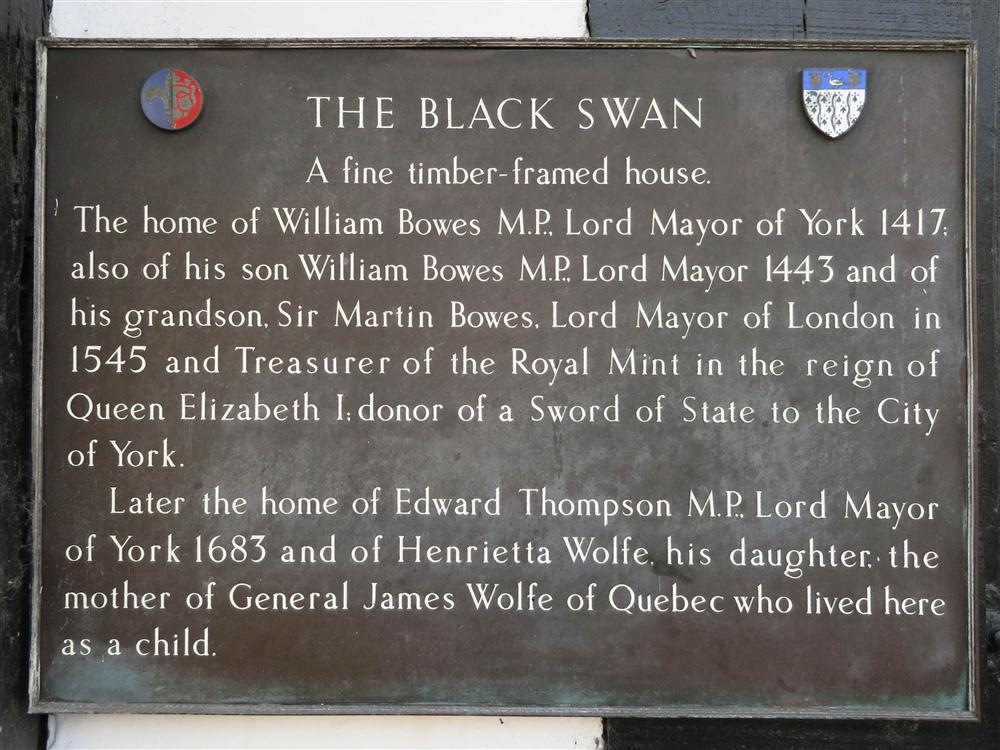
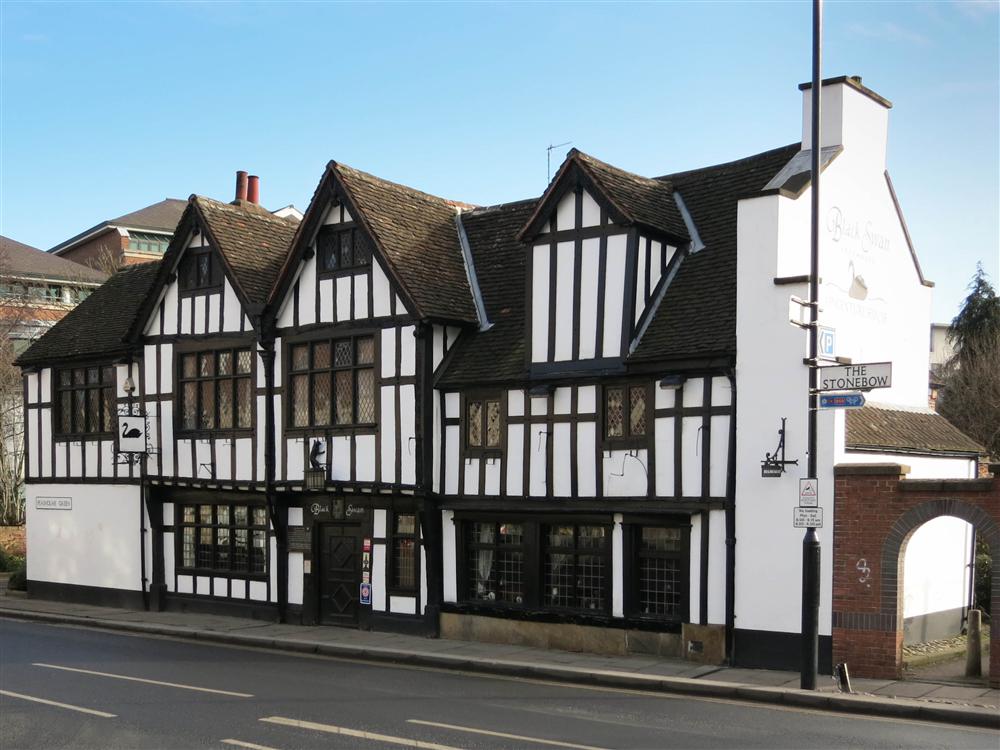 The Black Swan inn, in Peasholme Green, York, dates from the 15th century and was originally built as a family house for the Bowes family. William Bowes was Sheriff of York in 1417 and Lord Mayor in 1428. Sir Martin Bowes became an esteemed goldsmith in the City of London during the reign of Henry VII, later securing the position of jeweller to Queen Elizabeth I. In his capacity of Lord Mayor of London in 1545 he successfully negotiated with the York city authorities for the preservation of St Cuthbert’s Church and gifted to the city a valuable gem-encrusted sword which remains in the York civic possessions.
Gable ends were added to the timber-framed, two-storey building in the 16th century and main structural work occurred in the 17th century. It has a whitewashed and plastered front with the remainder in buff-orange brickwork. The jettied first floor and exposed timber-framing has had major restoration work and a 20th century extension completes the building

A medieval inn once stood on the site, the remains of which may well still be underneath the pub. The first record of the building as a pub dates to 1763 when it was advertised as having ‘good stabling, a wood warehouse and a larger chamber of its own’. Peasholme Green takes its name from the water meadows of the area which were once used for growing peas.
At one time it was thought that a passageway ran under the road, linking the pub to St Cuthbert’s Church, dating back to when the house was first built. The house was occupied by the Wolfe family prior to their move to America; General James Wolfe’s parents lived here from 1724 to 1726 although Wolfe was not born at the inn. Wolfe died while commanding the British Army at Quebec. Since 1932 members of the Royal Canadian Air Force have patronized the Black Swan.
Former staff had heard mention of the passage, but they had never found proof of its existence apart from one cupboard which had several steps leading downwards ending in a blank wall. In 2003 part of the floor was taken up during restoration work and evidently when electricians shone light down on it an old-style red brick floor was revealed leading off in the church’s direction. The building may at some time have been divided into two houses as two front doors are shown on old photographs.
During World War II the building became a horse refuge, and using the original large stables at the rear. Edgar Henry, the landlord in 1959, was quoted as stating that a brick maker of the city ‘sold his wife here, over a glass of ale, for 1s 6d in 1884’. In those days wife auctions were not unusual!
One of the pub’s ‘regular’ ghosts is a fidgety workman that wears a bowler hat and appears to be waiting or looking for someone as he walks through the pub. The bowler hats dates him to post-1850 and he is said to resemble Charlie Chaplin.
A ghost of a young woman wearing a flowing white dress often stands at the bar in the rear room staring into the fireplace and a pair of man’s legs are sometimes seen roaming around the staff’s quarters and descending a stairway.


Add comment