
 Horace
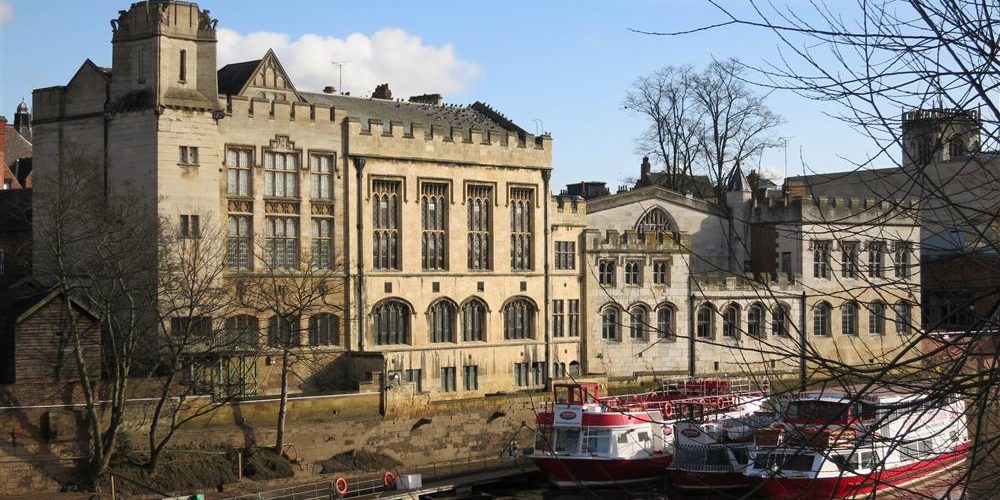
 Building of the present Guildhall, situated at the rear of the Mansion House, began in 1445 – the accounts from which are still in existence. The cost of a boatload of stone from the then market town of Cawood (10 shillings and 3 pence) was given to the workmen to buy drink when the foundations were laid. York’s original Guildhall is mentioned in a charter of Henry III in 1256.
For over five and a half centuries The Guildhall has served the Council and citizens of York and been the nucleus of the City of York Council. Records show that a council meeting was held in the Guildhall in May 1459. It served as a meeting place for the guilds of the city; these essentially had control of all trade within York, monitoring the quality of the workmanship and generally looking after their members’ welfare.
The many purposes of the Guildhall have led to it seeing history being made. In 1483 Richard III was entertained in the Guildhall, which also acted as a venue for the Court of Justice. Margaret Clitherow, who was charged with undercover and persistent perpetration of Catholicism, was tried there in 1586 at the City Assizes and subsequently executed by being pressed to death for her refusal to accept the court’s jurisdiction.
In the Civil War the sum of £200,000 paid to the Scots for supporting Oliver Cromwell’s Parliamentary forces is said to have been counted in the inner or ‘Justice Room’ in 1647. Charles I was duly handed over after the money was divided and paid out at Northallerton and Newcastle. Queen Victoria’s prince consort Prince Albert was a guest of honour at the Guildhall at a Royal banquet.

The Victorian Council Chamber, which is upstairs, was built between 1889 and 1891; the superb panelled room has original furniture. The walls are decorated in green and red with gold crowns and lions.
In WWII the Guildhall was severely damaged in an air raid in April 1942 and it was not until 1956 that restoration work began. In June 1960 The Queen Mother officially opened the completed replica of the 15th-century building – the mainly unscathed stone walls forming the frame of the reconstructed hall with a single tree trunk used for each oak pillar.
The Inner Room survived the raid intact; grotesque faces grimace down from the ceiling which is decorated with bosses and the room has panelled walls, masons’ marks and two secret staircases. As part of the 1960 restoration a superb West window was designed depicting many specialities of York life. Five lights in its tracery illustrate different periods of the city’s history. Munster, York’s twin city, presented a wrought iron balustrade as a lasting memorial.
The Guildhall continues as a multi-purpose building today, serving as a concert hall, council chambers and meeting place.


Add comment