
 Horace
 Eminent politician, lawyer, and businessman George Leeman, who was born in York in 1809, left his imprint on the city with his drive and contribution to the up and coming railway systems of his day.
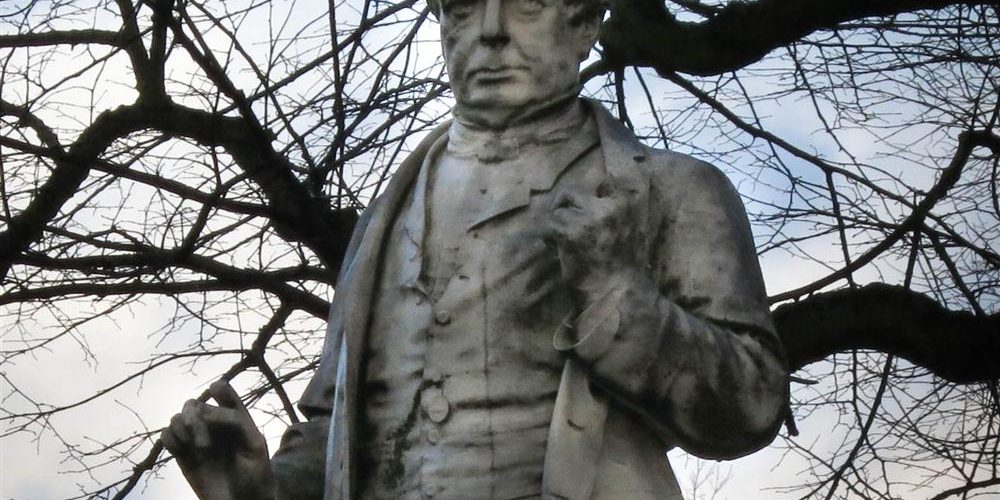
His imposing statue, by local sculptor George Walker Milburn and paid for by public subscription, stands near York Railway Station as a fitting tribute; it was unveiled in 1885. Station Road, now the site of the National Railway Museum was, appropriately, renamed Leeman Road that same year.
Leeman was a greengrocer’s son who chose to pursue a career. He became articled to a York solicitor following which at the age of 26 he established himself in a very successful legal practice – Leeman and Wilkinson of York and Beverley. He became a member of the Reform Club and the Yorkshire Philosophical Society from 1844 and from 1845 he was Clerk of the Peace for the East Riding of Yorkshire, being a member of the Society of Clerks of the Peace from1849. Additionally he was Deputy Lieutenant for the North Riding of Yorkshire.
George Hudson, York’s ‘railway king’, was a political rival of Leeman’s whose role in the investigations into Hudson’s illegal share dealings was instrumental in leading to Hudson’s downfall. In 1849 he succeeded Hudson as chairman of the York, Newcastle and Berwick Railway. Leeman instigated the merging of the two rail companies into the North Eastern Railways (NER) in 1854 becoming its vice chairman. The NER had its headquarters in York with Leeman as its chairman from 1874 to 1880; the company went on to be one of wealthiest railways in the country.

Leeman also held the position of chairman of The Railway Association of Great Britain and as such he presided over the 50-years’ celebration of the railways held in 1875 in Darlington. In 1880 he had to resign from his position with the NER though he continued as a board member until he died in 1882. His resignation was brought about by deterioration both in his health and wealth from the failure of the Rosedale and Ferryhill Iron Company, a mining company of which he was co-owner from 1860 to 1877.
Aside from his business connections Leeman was active in politics as well as being a director of the York Herald, and chairman of the Yorkshire Banking Company from 1867 to 1880. He was elected Lord Mayor of York in 1853, 1860 and 1870 having been an Alderman of the city for 28 years. As a Liberal MP for York between 1865 and 1880, Leeman was at all times a steadfast defender of the city’s heritage, initiating the renovation of a large extent of the city walls.
In his personal life George Leeman married twice, in 1835 and 1863, and had at least six children including three sons, one of whom, Joseph, followed in his father’s footsteps as a lawyer and then MP for York.
George Leeman died in Scarborough in 1882.


Add comment